Mexico’s most astonishing interviews

Impunity is a persistent theme in Mexican society. It has been manifest everywhere from the courts and elections, to the recent massacre in Guerrero. Many Mexicans are suspicious of the two major TV networks, Televisa and Azteca, whose bland and polished coverage has led not just to accusations of bias but to allegations of secret deals with political parties.

Yet there are some journalists, such as Carmen Aristegui and Jorge Ramos, who have established a reputation for rigorous reporting in the face of considerable pressure for conformity. Here are five occasions when key Mexican figures have come under scrutiny, and faced the questions that they are so keen to avoid.

1. Future president Enrique Peña Nieto forgets how his first wife died

For more than two years, there was speculation and rumour surrounding the early death of Monica Pretellini, the first wife of then Governor Enrique Peña Nieto. The magazine Proceso reported that even the doctors at the hospital were surprised by the cause of death, which was reported as an attack of epilepsy. The discovery that the Governor had two children with other women, and the deadly attack in the city of Veracruz on four bodyguards who were close to his family, further deepened suspicions.

It was in this climate that Jorge Ramos asked Peña Nieto about his wife’s death in 2009. Astonishingly, he failed to remember the name of the condition she had suffered from. In a follow up interview in 2011, Ramos asked him directly: “Did you have anything to do with her death?” Peña Nieto denied being involved, and described his inability to recall her medical condition as a “lapse”.

2. Elba Esther Gordillo is questioned on her wealth

The former teacher’s union boss Elba Esther Gordillo is notorious for her extravagant (tax-funded) lifestyle, Machiavellian maneuvering and fascination with the occult. Described as a “King-maker” by journalist Jo Tuckman, Gordillo has held enormous influence over elections by encouraging her 1.4 million union members to vote as a single bloc. In 2008, Televisa’s Carlos Loret posed some uncomfortable questions to “the Teacher” about her personal wealth and properties, which allegedly include a waterfront mansion in California, and some nine other houses in Mexico City and the United States.

It isn’t surprising that this line of questioning came from Televisa, which traditionally has links to the Institutional Revolutionary Party (PRI). By 2008, Gordillo had broken ties with her old party and was closer to the governing National Action Party (PAN).

This shift in loyalties may have been her undoing. It left her open to negative coverage from Televisa but crucially, it may also have contributed to her arrest for embezzlement in 2013.

3. Carlos Salinas de Gortari is confronted about suspected electoral fraud in 1988

On election night in 1988, there was widespread disbelief that the left wing candidate Cuauhtemoc Cardenas was ahead in the count. The election wasn’t rigged. After 59 years in power, the PRI party was finally on the way out.

Suddenly, a computer failure brought the system down. When it was restored, Carlos Salinas de Gortari, the candidate of the ruling party, had surged ahead in the vote, eventually winning the election by a 20% margin.

Cuauhtemoc Cardenas denounced the electoral fraud, but feared provoking a violent crackdown, so avoided confrontation in the streets. Anger about the election lingers on, and in 2008, Jorge Ramos questioned former President Salinas on the shady circumstances surrounding his rise to power.

4. Subcomandante Marcos is questioned on his identity

Subcomandante Marcos shot to fame in 1994, when the Zapatista army launched an uprising in Chiapas, one of the poorest states in Mexico. It was a brief, symbolic rebellion, but one that seized the imagination of millions across Mexico and abroad.

Two years later, and hidden behind his famous mask, the Zapatista spokesman looked uncharacteristically bashful, adjusting the balaclava and emptying his trademark pipe. He was being questioned about his identity, and the family he had left behind.

His interviewer Jorge Ramos suggested that he was Rafael Guillen, the son of a Spanish salesman from the state of Tamaulipas, and a former philosophy lecturer in Mexico City. Marcos denied the claim, jokingly pleading with female viewers not to believe Ramos, and followed with several enigmatic statements presumably designed to obscure and distract.

His reaction revealed a personal side to the man behind the Marcos persona.

5. Drug Lord Rafael Caro Quintero is interviewed by reporters

Rafael Caro Quintero is a founding member of the Guadalajara Cartel, a drug trafficking organization that was initially granted immunity by the CIA due to its “charitable contributions to the Contras” in Nicaragua. In Mexico, he is known as “the Narco of Narcos” and has been accused of a series of murders, including that of American DEA agent Enrique Camarena.

In 1985, he was detained for his part in Camarena’s murder and sentenced to forty years in prison. He was questioned by reporters a month after his arrest. It was the first television interview with a criminal leader of his stature, and he cut a surprising figure for a man facing a murder charge. The curly haired gangster smiled and joked for the cameras, almost seeming to enjoy the spotlight.

In 2013, a tribunal ordered his release, having discovered that he was improperly tried in a federal court for crimes that should have been handled at the state level. Under pressure from the United States, the Mexican authorities issued another arrest warrant just days after his release but so far he has avoided recapture.

Twitter: @Stephentwoodman

Posted in Politics | Tagged , , , , , , , | 4 Comments

Femicide in Mexico: Family of murdered woman await justice, demand new legal interpretation

Imagen1

Imelda Virgen

Little has changed in the two years since Imelda Virgen, a 40-year-old Guadalajara psychologist, was beaten to death on the orders of her husband. The suspects remain in custody but have yet to be sentenced.

Much to the disappointment of the family, authorities have refused to classify the case as a femicide (a crime motivated by hatred of women) despite the requests of human rights groups.

This appears to be the norm. According to the Committee of Women’s Rights in Latin America and the Caribbean (CLADEM), 1,061 women have been murdered in Jalisco since 1997. In 2013, only 12 of the 133 murders of women were classified as femicide. Of these, only one individual was sentenced for the crime.

Meanwhile, the Virgen family is forced to live with their bereavement and uncertainty, campaigning to make their voices heard in a society wracked by violence against women.

“Months ago, life was full of restless, daily fluctuations,” Sofia Virgen said at her sister’s memorial. “With joys that you wait for and feel certain will arrive, joys that you live intensely without realizing that they might never return. In the house, the rush of your high heels told us whether you came or went. Your presence brought a smile that gave us peace. Suddenly one morning, that world left without trace: police, nurses, and public officials told us things that neither our hearts nor our minds understood, the color red, the shock, the broken heart of a mother, your still body under a roof of glass, and the pain of your violent death mixes with the memories of your sweet life.”

04_Homi_Gilberto-Enrique-Vázquez-Cortés

Gilberto Enrique Vazquez Cortes

Gilberto Enrique Vazquez Cortes, a 44 year old psychologist, testified to the police that on the night of September 28 2012, he drove Imelda’s blue Chevrolet to collect her from the city center, where she taught at the University of Guadalajara. Soon after she got in the car, two men opened the back doors and forced their way in. He said they ordered Vazquez Cortes to drive in the direction of the industrial zone. Upon arrival, they forced Imelda out of the vehicle. She was raped and beaten to death. The two assailants escaped in the car, and Vazquez Cortes contacted the police.

When the police arrived, they questioned Imelda’s husband and discovered various contradictions in his version of events. They pressed him for details, and he buckled under pressure, confessing to having hired the men to murder his wife in exchange for the Chevrolet and a payment of 50,000 pesos (about $3700).

A week later, two suspects, David Ceja Calzada and Sergio Fabián Sánchez Belmontes, were arrested along with a suspected accomplice, Joceline Juviana Calzada Ceja. Another man, Emmanuel Álvarez Quezada, told the police that Vazquez Cortes had tried to convince him to hire someone to murder his wife.

“He told me that he wanted to kill her before they divorced so he could collect the life insurance,” Álvarez Quezada testified.

The violence of Imelda’s death contrasts starkly with her life. A child psychologist who worked for the University of Guadalajara, in her spare time she led yoga classes, illustrated, and rescued stray dogs.

The tragedy has turned the Virgen family into activists. Her sisters have set up a Facebook page: “Justice for Imelda Virgen, Justice for All,” that keeps members updated on the case.Imagen2

Yet the campaign has been ignored by state authorities, who designated the crime a parricide, and refused to classify it as a femicide. This is despite a reform, passed five days before Imelda’s death, that recognized femicide as a distinct crime under the penal code of Jalisco.

For CLADEM coordinator Maria Guadalupe Ramos Ponce, the refusal highlights the disinterest of the judicial authority in applying a gender perspective to their investigations. “What they’re trying to do is ignore the problem,” she said.

niunamas

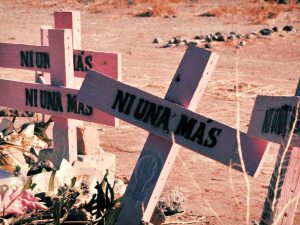
“Not another more”. Crosses erected in Ciudad Juarez mark the place where the bodies of eight women were found. The border city has been notorious since 1993 for its rates of femicide and impunity.

In June of this year, a member of the police (asking to remain anonymous) spoke to local newspaper La Cronica de Hoy. “If the suspect doesn’t confess that he killed her because she was a woman,” he said, “we don’t classify it as a femicide.” According to the officer, detectives had “been asked not to box things into that category unless there exists no other possibility.”

Yet the sociologist Celia Magana is critical of this approach. “The categorization of femicide would help to establish a climate of condemnation towards violence against women.” She believes that femicide is a public rather than a private problem. “It’s not just a social and cultural problem, but an institutional and political one,” she said.

The non-governmental organization Mundubat has also pointed to the connection between violence against women and wider social conditions. It argues that the phenomenon has its root causes in educational and economic inequality, with less equal societies tending towards higher rates of violence.

There is even a correlation between the rise in femicides and the violence of the drug trade, according to a study carried out by Mexico’s National Commission to Prevent and Eradicate Violence against Women (CONAVIM), which showed the number of killings more than doubling in the five years following the escalation of the drug war, rising from 1,119 in 2007 to 2,630 in 2012. The study provided a stark indicator of how organized crime affects the population, even when they are not directly involved in the drug trade.

Numerous campaigns, some organized by high-profile, international groups such as Amnesty International, have highlighted the incremental nature of violence in relationships. As Celia Magana points out, the physical abuse is preceded by psychological and verbal mistreatment: “Femicide is just the last phase of a chain of violence.”

Imelda Virgen’s case is typical in that her death was the culmination of a pattern of abuse. The aggression began with accusations and stalking.

“I always suspected that she had been unfaithful,” Vazquez Cortes decViolencia-contra-la-mujerlared in his police statement two years ago. “On several occasions, I followed her to find out who she was with. I never caught her, but since I suspected that she was having an affair, I wanted revenge.”

After Imelda went back to live with her family, her husband directed his anger at her pets, poisoning her dogs while she was away. When she decided to divorce him, he started planning her murder: “If you´re not mine, you’re nobody’s,” he later remarked on his thinking.

Vazquez Cortes made a second statement at a hearing on May 2 2013, but his version of events had changed dramatically. He currently claims that the police forced his confession. “It’s false that I paid anyone. It’s false that I hired them,” he wrote. Statements by the other suspects however, coincide in their presentation of him as the intellectual author of the crime.

The Virgen family is still waiting for the verdict. Meanwhile, they continue to campaign for greater awareness of gender violence. They led a march yesterday to commemorate two years since Imelda’s death.

Twitter: @Stephentwoodman

Posted in Crime | Tagged , , , | 1 Comment

Why artists choose Mexico as a setting

Mexico DF 204

Mexico has always attracted a wide roster of foreign artists and intellectuals. Among those who pursued their creative vision in the country are U.S. writers Katherine Anne Porter and William Burroughs, British novelist Graham Greene, Russian revolutionary Leon Trotsky and his countryman, filmmaker Sergei Eisenstein.

Even more have seen Mexico as an appropriate setting for their work. Orson Welles, Cormac McCarthy and Roberto Bolaño are among the many that have drawn inspiration from the culture and history of this mysterious, varied land.

As a setting, Mexico has a lot going for it. Often it is simply a good place for characters to escape to, the fictional flight reflecting the reality that Mexico really is a popular destination for U.S. fugitives. James Ellroy, Don Winslow and DBC Pierre are top of a long list of writers who write about an escape to the border.

Mexico is often portrayed here as a wild and dangerous land, liberated from the oppressive conventions of Anglo society and law. In fact, according to psychologist Geert Hofstede’s “Uncertainty Avoidance Index,” Mexico is a traditional, conservative society where behavior is codified to a similar degree as in South Korea.

In foreign literature and film however, it is transformed into a deregulated, unpredictable space.

The border in particular, is shown to be a savage landscape where no one is to be trusted. Frontier towns hold a special fascination. If all art is about conflict and contrast, there’s nothing more artistic than a border. The cultural, economic and linguistic divisions lend themselves to the imagination and are a great catalyst for action.

GTY_border_patrol_jef_131004_16x9_992

The extremes of the border match the experience of the protagonist, showing how far they have come on their road from safety. “If the world was flat, you just know the edge would look like this,” says the teenage narrator of the novel “Vernon God Little.”

Part of the draw of the border is its violence, the perception that it is a place where death is always near. Mexico in general is often imagined as a country where death is central, and is celebrated rather than denied.

This is partly because of the Day of the Dead, the national holiday where graveside offerings are made and candy skulls are eaten by children. It is also because daily Mexican life abounds in images of death. Churches house spectacularly bloody crucifixes, jokes use death as a theme and newspaper coverage of murders is typically highly graphic.

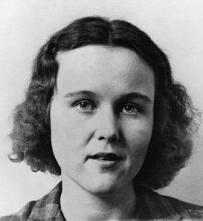
In fact, a number of famous visitors did meet a bizarre and grisly demise in Mexico. Trotsky had an affair with Frida Kahlo and was expelled from the home she shared with muralist husband Diego Rivera. He ended up in a nearby house with less suitable security arrangements, a fact that contributed to his being murdered by a pick axe wielding assassin. Joan Vollmer, the wife of William Burroughs, was shot dead by her husband in a drunken game of William Tell. Neal Cassady, the inspiration for the hero of Jack Kerouac’s “On the Road,” froze to death while walking along the railway tracks at night.

         leon_trotskynealJoan_Vollmer

Nevertheless, none of the above died because Mexico really is a dangerous dystopia, but because of their own risky and impulsive behavior. It may well be that Mexico can inspire great recklessness as well as great art, probably for similar reasons.

Mexico’s death traditions have roots in both Aztec ritual and Spanish Catholicism. The encounter of these two cultures still lingers over Mexican life, and most foreign artists are aware of this. Mexico, says Malcom Lowry, is “the meeting place, according to some, of mankind itself.”

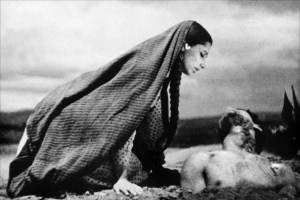
Sergei Eisenstien was fascinated by this coexistence of cultures. The millionaires of the capital are only an afternoon’s drive from people whose way of life is closer to their pre-Columbian ancestors. In his work on the script of “Que Viva Mexico!” he was inspired, he said, by the “montage of culture” itself, “where movement through space, from one province to another, is also a voyage through centuries of time.”

                                      queviva2

The Mexico of the imagination is a place of eternal contradiction. Uncle Sam meets Saint Death, the foreign-born exclude locals, and the biggest threats seem to come from within; from insurgents and criminals and those sworn to protect. It is a chaotic space that fires the imagination. The Australian writer DBC Pierre is one of many who credit the country with setting him on an artistic path:

“Mexico, with its contrasts, its crushing poverty and sparkling wealth, its institutionalized corruption and cultural wisdom, its love of life and its embracing of death, undoubtedly set me on a path toward the deep end, philosophically and emotionally speaking.”

Twitter: @Stephentwoodman

Three of the best fictional Mexicos:

Malcolm Lowry’s – Under the Volcano

91nxw4439yL._SL1500_                                                        

A modernist masterpiece following a day in the life of the alcoholic former British consul and his estranged wife Yvonne. The novel is loaded with symbolism and is worthy of multiple reads. It’s also full of observations on the humour and strangeness of daily Mexican life: “How, unless you drink as I do, could you hope to understand the beauty of an old Indian woman playing dominoes with a chicken?” asks the former Consul. The dark, dense narrative is designed to reflect the drunkenness of its central character. “Far above him a few white clouds were racing windily after a pale gibbous moon. Drink all morning, they said to him, drink all day. This is life!”

Roberto Bolaño – 2666      

2666_hcvr

The Chilean’s postmodernist epic “2666” was the final novel he wrote before he died from a liver disease caused by youthful heroin abuse. It is set in the sprawling border town of Santa Teresa, a fictional reworking of Ciudad Juarez inhabited by “people staring nightmare in the face.” It follows the lives of dozens of characters, all affected by a mysterious and horrifying wave of mass murder that sees as many as 400 young women killed. It hints at possible reasons for the killings; from the global capitalism that brought the women and the factories to town, to the drugs that seem to be involved in every aspect of city life. “Everything in this town is about drugs,” one character says. A roaming black SUV reappears throughout the story, representing the unstoppable force of evil that haunts the city. A gripping and chilling novel, seen by Stephen King as a mural of a “society that appears to be eating itself alive.”

DBC Pierre – Vernon God Little

610hm4aA7jL._SL1203_

DBC Pierre’s Booker prize-winning debut is written in a distinctive and witty first person voice that draws the reader into the narrator’s Texan world. A Columbine-style shooting has left 16 dead, and the narrator Vernon, the killer’s best friend, is suspected of involvement. Seeking to escape the police and media, Vernon flees to Mexico. “Reynosa is the town on the Mexican side of the bridge. It’s big, it’s messy, and there’s a whiff of clowns and zebras in the wings, like any surprise could happen, even though it’s the dead of night back home.” Legendary director Werner Herzog is making a film adaptation of the novel.

Posted in Arts | Tagged , , , , , , , , , , , | 1 Comment

Renegade priest still speaking “language of the poor”

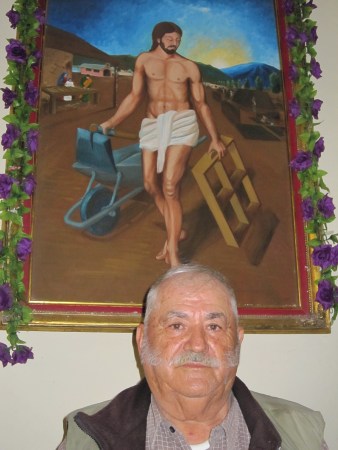
The first time I encountered José Álvarez Franco, better known as Padre Patillas, or “Father Sideburns”, was during a baptismal service in his church in Tateposco, when he referred to me as a “gringo” during the mass, prompting laughter throughout the congregation. He had got facts wrong, I’m actually a limey; but it didn’t really matter, the impression had been made: this was a priest with an unconventional style.IMG_1828

This impression was strengthened by the setting of the church, an elegant red brick building perched high in the hills of Tateposco; there were a collection of animals, chickens, and cats living behind the building, with dogs wandering in and out during the service.

It also became clear that Padre Patillas’ renegade approach extended into his politics. Before the service, a speaker was invited to the altar to protest the reforms of the Mexican President, Enrique Peña Nieto. The priest himself announced: “this is the church of the poor, not of the rats working in government!”

This confrontational style contributed to his suspension from the church in 1983. Following this, he continued organizing and protesting with the people of his district, and even came into conflict with local authorities. “The police came here once twenty years back and they wanted to take me away, so we gave them a few smacks and sent them on their way,” he boasted.

767716

Héctor Álvarez Contreras

The years have certainly not tamed him. Padre Patillas remains as fiery as ever. In an expletive laden video of a visit between the priest and the local National Action Party (PAN) deputy, Héctor Álvarez Contreras, he was asked by the politician about his choice of language: “Father, why do you speak like that?”

“The people who don’t use the language of the poor are against them,” he said. “The language of the poor is the most beautiful, and we as people who love the poor, must use their language.”

cardenal-jesus-posadas-ocampo-300x350

Cardinal Juan Jesús Posadas Ocampo

Such was the animosity between him and the conservative Cardinal Juan Jesús Posadas Ocampo, that there were even rumors, sparked by the local television Channel 7, that he was behind the drug cartel assassins that shot the cardinal dead. Padre Patillas now sees these claims as amusing: “They came here to interview me, expecting to find a great thug from the mountains, but there I was: a short, fat priest.”

Yet such attacks from the church hierarchy and media have only strengthened his status amongst his supporters. “He has always been admired and seen as a role model by many of the younger generation of priests in Mexico,” says Dr. Renée de la Torre, a local academic. The Cuban journalist Carlos Rafael Diéguez even described him as the “highest representative of the gospel in Mexico.”

The renegade priest’s language draws on the themes of liberation theology; a political movement that developed in the 1970’s and takes its name from a book by the Peruvian Gustavo Gutiérrez. In this book, A Theology of Liberation, Gutiérrez argues that it is a Christian duty to free people from poverty by addressing institutional sin.

Many liberationists see things such as rosary beads and devotion to saints, among other forms of religiosity popular in Latin America, as non-transformative; irrelevant distractions that keep people docile.

Critics of the movement have called it Marxism, a secular invasion of the church that redefines liberation as freedom from economic hardship, rather than from the true slavery of sin. Pope Benedict XVI even called the movement “a fundamental threat to the faith of the church.”

Yet a combination of ecclesiastical measures, instigated by Pope John Paul II, and continued by his predecessor, diminished the influence of liberationists. Conservatives were routinely appointed to the top church positions in Mexico, a trend that was imitated across the continent.

“Once the bishops, and the Pope, began actually using their authority,” said Professor Edward Lynch, of Hollins College in Virginia, “it forced the liberationists to make the stark choice of defecting, and losing much of their standing with devout Latin Americans, or remaining in the Church and submitting to the loss of many of their institutional bases.”

Yet the language of liberation theology assumed a new relevance following the global financial crisis of 2008, and the hierarchy that had targeted the liberationists was itself being undermined by a series of abuse scandals that rocked the standing of the church worldwide.

The appointment of Pope Francis, the first Latin American pope, in 2013, further opened the church to liberationist ideas. This was a man who had preached in the slums, who saw social action as essential, not heretical.

09272013p09pha

Gustavo Gutiérrez

Indeed, one of the Pope’s first gestures was to invite Gustavo Gutiérrez to Rome. He then called for the beatification of Oscar Romero, the Archbishop of El Salvador who had been shot dead by a government assassin while celebrating Mass in 1980.

His language has shown a new openness to left wing concerns. He has called for a “legitimate redistribution of wealth,” saying governments should work to end the “economy of exclusion” that exploits the poor.

This change in tone is not lost on Padre Patillas, who has a banner next to his altar in Tateposco that quotes the new Pope: “to be a modern Christian is to be a revolutionary.”

Yet the priest is also keen to emphasize the biblical orthodoxy of his beliefs: “Whether or not I follow liberation theology is not so important, I follow Pope Francis,” he said. “I promoted these ideas in the past, but we are not in service to socialism. We are in service to the gospel.”

395744_10150459853413175_682058174_8679491_2078859811_n (1)

Andrés Contreras

In performing this service, he has become something of a celebrity. The protest singer Andres Contreras has even written a corrido celebrating him: “My song is a protest, against all of the aggressions, that an honest priest has suffered, a priest without greedy ambitions, that’s at the side of the poor in all of their afflictions.”

Twitter: @Stephentwoodman

Posted in Religion | Tagged , , , , , , , , , , | Leave a comment

Seven meetings that shaped Mexico

Mexico, according to Malcolm Lowry, is “the meeting place of mankind itself,” where European and Aztec civilization first made contact. Every year, many Mexicans gather at their family graves to meet with the spirits of departed loved ones. In business etiquette, first impressions are of utmost importance, and establishing a personal rapport is essential for negotiations.

Whether it is cross cultural encounters, assemblies with the dead, or the building of personal and business relationships, meetings are a key to the culture. Here are seven that shaped the country since the arrival of the Spanish.

1. Hernán Cortés meets La Malinche, present day Tabasco, 1519

Tlaxcala_-_Palacio_de_Gobierno_-_Verhandlungen_Spanier_-_Tlaxcalteken_2In April 1519, Doña Marina, or La Malinche as she is commonly known, was among 20 slave women given to Hernan Cortes as a gift from a Mayan warlord. Her exact age at the time is unknown, but it is assumed she was in her late teens. The chronicler of the Conquest, Bernal Díaz del Castillo, remarked on her beauty; and she was the only one of the slaves whose name he remembered. She worked as an interpreter and mediator, mastering Spanish in weeks, and later became Cortes’ lover. She played a pivotal role in events, with Cortes even writing: “after God we owe this conquest of New Spain to Doña Marina.”
2. Cortés meets Moctezuma II, present day Mexico City, 1519

Malinche_con_Cortes

On November 8, 1519, Emperor Moctezuma came with a procession of lords to meet Cortes on the bridge leading into his island city. The Aztec leader gave the Spaniard a golden calendar as a gift, which Cortes melted down for its material value.

Moctezuma brought Cortes into his palace, and the Spaniards stayed as guests for several months. At some point, he became a hostage in his own home, which eventually sparked a rebellion amongst his own frustrated people. Cortes forced Moctezuma to address an angry mob from the palace balcony, and he was hurt by rocks thrown from the crowd. He later died from his injuries, or was murdered by Cortes, depending on which version you believe.

3. General Santa Anna meets Sam Houston, present day Texas, 1836

SantaAnnaSurrender

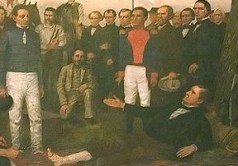
General Santa Anna was an eccentric military leader and president who ordered a ceremonial burial for a leg he lost in battle. His political blunders make his name a continuing cause of controversy in Mexico. Sam Houston was the commander of the Texan army that fought for independence from Mexico. In 1836, his forces surprised Santa Anna’s, defeating them in the battle of San Jacinto.

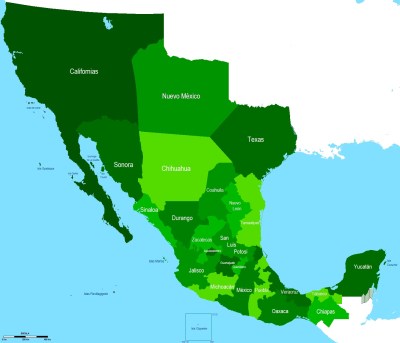
The Texan militia rounded up the Mexican soldiers, and Santa Anna initially evaded discovery by changing into the uniform of a common soldier. The tactic worked until he was exposed by one of his own men, who referred to him as “Presidente” in front of the Texans. His true identity exposed, he was brought before Sam Houston, who had been wounded in battle. In exchange for his life, Santa Anna signed over all Mexican rights to Texas. It was the beginning of a process that would eventually see Mexico lose more than half of its territories to the United States. By 1848, it had lost all of Texas, New Mexico, Arizona, Utah, California, and Nevada as well as parts of Colorado, Wyoming, Oklahoma, and Kansas. The bungling General responsible is even vilified in the Molotov song “Frijolero”: “If not for Santa Anna just to let you know, that where your feet are planted would be Mexico!”

Mexico_1835_(Siete_Leyes)

4. Frida Kahlo Meets Diego Rivera, Mexico City, 1928

022-frida-kahlo-and-diego-rivera-theredlist

While the student Frida Kahlo used to spy on muralist Diego Rivera as he painted at her school in 1921, their first face-to-face meeting wasn’t until seven years later, at a party hosted by Italian actor Tina Modotti. Frida, who had an unpredictable personality herself, enjoyed seeing Diego pull a pistol and shoot the phonograph. For Diego, it was the meeting that would define his life: “I did not know it then, but Frida had already become the most important fact in my life, and would continue to be up to the moment she died, 27 years later.”

 5. Roberto Bolaño meets Octavio Paz, Mexico City, 1974

In 1974, the Nobel prize-winning poet Octavio Paz had the misfortune of meeting a yooctavio-paz-centenario-3-1024x1024ung, angry Roberto Bolaño, the Chilean novelist who went on to write postmodern masterpiece “2666”. Bolaño’s group, the “Infrarealists” saw Paz as the embodiment of the establishment, a suited villain who cozied up to power.
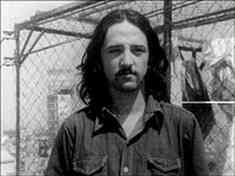
The writer Carmen Boullosa was 20-years-old when she encountered Bolaño and his circle at Mexico City poetry readings. She writes, “With my own eyes I saw a group of Infrarealists throw the contents of a glass over Paz (very smartly dressed, bolano200-f30d2c0c50e27f43dd884f73d1869cca84337329-s6-c30in an elegant blazer) who shook out his tie and continued conversation with a smile, as if nothing happened.”
At another event, Bolaño set out the reasons for his hatred of Paz: “his odious crimes in the service of international fascism, the appalling little piles of words that he risibly calls his poems, his abject insults to Latin American intelligence.”

6. Carlos Salinas meets Carlos Slim, Mexico City, 1982

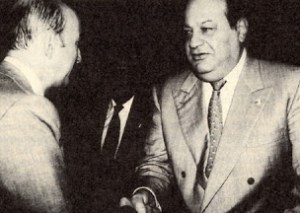
Carlos Salinas is the former president of Mexico who came to power in the rigged elections of 1988. Carlos Slim is the owner of Telmex, formerly the richest, and currently the second-richest man in the world. The pair met at a dinner in 1982. It was the start of a friendship that would shape the next three decades of Mexican history. Slim was at the banquet in 1994 when Salinas appealed to the country’s millionaires to provide financial aid to the campaign of his chosen successor as president, Ernesto Zedillo, and was almost certainly influential in keeping the country out of the hands of the left-leaniPROCESO Slim y Salinasng PRD.

For his part, Salinas sold the national telecoms company Telmex to Slim in 1990. It was an auction that rivals alleged was fixed.

“Regardless of whether there was favoritism in the sale of Telmex,” said David Lunhow, writing in the Wall Street Journal, “the privatization process created a new class of super-rich in Mexico. In 1991, the country had two billionaires on the Forbes list. By 1994, at the end of Mr. Salinas’s six-year term, there were 24. The richest of them all was Mr. Slim.”

7. Guillermo del Toro meets Alfonso Cuarón, Mexico City, 1987

16253935

The director of “Pan’s Labyrinth” met the director of “Gravity” in 1987, while both were working on a Mexican horror series.

“It was an episodic thing like ‘The Twilight Zone’,” Cuaron said. “We used to call it ‘The Toilet Zone’ because of the budgets.”

“I remember, right after I did my first one, this freak from Guadalajara walks into the office and says: ‘You’re Cuaron, right? I’m Guillermo del Toro. I saw your show, and it was a rip-off from a Stephen King story.’ I started laughing, and I said, ‘You’re the one guy who figured it out!’ And he said, ‘Yeah, man, but your show still stunk.’ I started laughing even louder. I loved the guy immediately.”

Twitter: @Stephentwoodman

Posted in Culture | Tagged , , , , , , , , , | 3 Comments

The rise and rise of Mexican Mormonism

158427407_55d705334e_b

Until two years ago, when Mormon missionaries knocked on the door of his family home, José Guadalupe Pérez had never heard of The Church of Jesus Christ of Latter-day Saints. He had no idea what a Mormon was, nor what they believed or practiced. Yet he was impressed by their manner, their enthusiasm and energy, and he soon started meeting with them for chats about the faith.

“At first I liked the missionaries because they were friendly and they listened to me,” he said, “but as I heard more, I began to realize that it was the truth.”

Converts like José have made Mexico home to the largest body of Mormons outside of the United States, with the church reporting over 1.2 million members in the country. There is a huge temple in Zapopan, one of thirteen in the country, and around 200 foreign missionaries in Guadalajara alone, with thousands more local believers.

The converts are transforming the demographics of the church, and the projection is that the majority of Mormons will be Latin American by the end of 2015. “The Church has allocated much of its mission resources to reaching Latin America and Spanish-speakers in the United States,” Matt Martinich, a church-growth researcher, said. “This population has also exhibited higher receptivity to outreach than many other people groups.”

So what draws them to this traditionally Anglo-American faith? Some analysts see underlying cultural similarities.

“I think one of the reasons the church has grown so much in Mexico is that the culture has had an inclination towards the spiritual since ancient times,” said Tomás Hidalgo, a former church spokesman in Mexico. Others point to the declining influence of the Catholic Church, and to the Mormon missionary impulse, which has seen them organize recruitment drives throughout Latin America.

The first missionaries came to Mexico in the late nineteenth century. Fueled by criticism at home, the church sought expansion.

“Mormons sharpened their tools in situations of intense competition for followers with other Christian groups,” said Laurie F. Maffly–Kipp, a Professor of Religion at Washington University in St. Louis.

Conversion rates have risen to the extent that the Mormon minority is now large and conspicuous. Yet few outside the faith are familiar with their beliefs, fewer still are aware that their history is inextricably tied to Mexico.

Mormon theology holds that Joseph Smith, a charismatic farmer’s son from New York, recovered some golden plates given to him by an angel. The plates, translated into the Book of Mormon, tell the story of an ancient tribe of Israelites who sailed to, and settled in the Americas. Shortly after his Resurrection, Jesus Christ visited this faithful tribe, and told them to reorganize his church.

Archaeologists have noted that American indigenous groups are of Asiatic origin, not Israelite, as the Book of Mormon contends. They have also pointed out that the horses, cattle and elephants in the story were unheard of in Pre-Columbian America.

Yet it is here that the first link with Mexico is found. Since the early years, Mormon researchers have looked to Mesoamerica’s ancient civilizations to provide support to their foundational narrative. Some apologists believe that the Mayan ruins on the Yucatán Peninsula belonged to Book of Mormon peoples. So to many Mormons, it’s no surprise that Mexicans would take an interest in their faith. “They have all these pyramids right in their backyards offering proof of what is talked about in the Book of Mormon,” said Ann Goulding, a church elder from Utah.

The second link with Mexico is tied to its most controversial early practice. Polygamy among early Mormons was encouraged by Smith, who himself is thought to have had as many as fifty wives. Opposition to polygamy led many Mormons to emigrate to Mexico, and colonies sprang up throughout the north. One of these, Colonia Juarez in Chihuahua, was the birthplace of the father of presidential candidate, Mitt Romney, and it became the center of a flurry of media interest during the election of 2012.

Mexico, in short, is a special place for Mormons, a second home providing a legal and intellectual shield from criticism in the United States. Yet the modern Mexican church is growing through conversion, not immigration, and this is a process that throws up challenges. The church’s growth has slowed down slightly over the past three years, mostly because many converts are baptized too quickly, and soon stop attending. “Many new members lack the commitment to regularly go to church and become a contributing member” Matt Martinich said. Bryan Lott, a volunteer missionary, also finds cultural attitudes a problem.

“The biggest challenge I feel is the strong sense of tradition. Many times they believe what we are teaching, but they can’t change because of family tradition.”

Yet the slowdown shouldn’t fool you: church growth is still steady, with membership rising by 3.5% in 2012 alone. There may not yet be a Mexican Romney, but Hidalgo predicts that there will be in the future.

“The flourishing of our members in important positions of Mexican society is just starting,” he said.

“The church has reached a level of respect that it obviously didn’t have at the beginning, and we are in a period when the harvest is going to be big.”

Twitter: @Stephentwoodman

Posted in Religion | Tagged , , , | 1 Comment

Hair theft on the rise across Latin America

In June 2011, a 23-year-old woman was walking to a bus stop in the center of Guadalajara when she saw a dark figure approaching, armed with a pair of scissors. The assailant jumped in front of her and shoved her in the direction of an alley behind the main street. Once there, he pushed her face to the wall and sliced off her ponytail.

???????????

It was the first case of hair theft in Mexico’s second-largest city, but since then, there have been a spate of similar attacks. Scissor wielding thieves have been targeting victims for their long hair, in many cases simply approaching on foot or on a scooter, and cutting off as much as they can. The stolen hair is later sold on the black market for extensions, where it can be worth up to US$60 apiece, a price comparable to a stolen cell phone.

Hair extensions are increasingly popular in Mexico and can be bought in beauty salons for anything from US$100 to US$500. Yet the popularity and price of these products is driving the theft.

Chairman of Guadalajara’s Security Commission Jose Luis Munguia Cardona says that the widespread use of scooters by thieves has taken the crime to a new level. “We have seen more and more of what have become known as scooter-rats or scooter-thieves. These criminals work with one riding the scooter and another sat behind. The role of the second thief is to grab cellphones, handbags or even in some cases human hair, which is chopped off and sold as hair extensions. These products are apparently very expensive,” he said.

There has been a sharp rise in hair theft across Latin America, with incidents reported in Columbia, Brazil and Argentina. To be valuable, the hair must come from a single person, and it is a crime of convenience, because the victims can be selected based on their appearance.

Hair theft, while undoubtedly on the rise, is not an original offense. Significantly, it was a popular crime in Europe and the Americas throughout the nineteenth century. As early as 1863, “The Hairdressers’ Journal” was decrying the trend:

“Even in the present day it has happened over and over again that a good crop of hair has been laid in wait for, and shorn from the trembling victim, who has been only too glad to get free with but the loss of her hair.”

The parallel between Victorian London and present day Latin America is worthy of scrutiny. Until the distribution of wealth in the region ceases to resemble that of nineteenth century Europe, crime in the continent will likely retain its anachronistic flavor.

 Twitter: @Stephentwoodman

Posted in Crime | Tagged , , , | Leave a comment

What was great about Gabo?

The news that Gabriel Garcia Marquez, the Colombian Nobel prize-winning author, died yesterday led to an outpouring of tribute in the press, across Twitter and from a wide array of celebrities. The Colombian president, Juan Manuel Santos, described him as “the greatest Colombian of all time.” Obama called him one of the world’s “greatest visionary writers.” Whereas Mexico’s president Enrique Peña Nieto was forced into the uncomfortable position of expressing regret on behalf of Mexico, Marquez’s adopted home, reminding everyone that in 2011 he had himself failed to name three books that he had read.

Garcia Marquez was a rare literary figure, beloved as much by the people as by the critics. His novels outsold everything in Spanish except the Bible. His most famous work, the epic 1967 novel, One Hundred Years of Solitude, sold more than 50 million copies in more than 35 languages.

Jorge Luis Borges, his Latin American predecessor, has a comparable standing among academic critics. Yet for the most part, his writing is devoid of the passion and sentiment that made Garcia Marquez, affectionately known as “Gabo”, a Latin American literary icon. Borges was a genius, Gabo was more.

Image

In 2004, Garcia Marquez changed the last chapter of his novel Memories of My Melancholy Whores in an effort to outwit the pirates selling his bootlegged work on the streets of Colombia. You can imagine few other writers, (J.K. Rowling notwithstanding) whose novels create such anticipation that it becomes more of a burden than a blessing.

Gabo popularized the genre that has become known as magical realism, an emotionally charged literary style that blends reality, myth, the mundane and the supernatural. He was not the first proponent of this style but he became its master.

According to his account, the journey began when the struggling novelist was driving from Mexico City to the beach resort of Acapulco. The first sentence of his landmark novel sprang fully formed into his mind.

“Many years later, as he faced the firing squad, Colonel Aureliano Buendia was to remember that distant afternoon when his father took him to discover ice.”

Marquez spun the car around, and returned home to write it. Twelve months later, and $12.000 in debt, he would be finished.

The novel tells the story of several generations of the Buendia family, who live in the tropical town of Macondo, an isolated settlement which develops into a thriving town through the introduction of a railway and banana plantation. The novel explores social, economic and political themes but contains supernatural elements that many critics label “magical” or “folkloric.”

Yet Garcia Marquez always denied that his fiction was the product of pure invention.

“The truth is that there’s not a single line in all my work that does not have a basis in reality,” he told the Paris Review in 1981.

In The Fragance of Guava, an extended conversation with the author, his interviewer, Plinio Mendoza is skeptical about this claim, pointing to the story of Remedios the Beauty, Macando’s most beautiful inhabitant, who ascends into heaven. It was based, Gabo claims, on a woman whose daughter had run off with a lover. The woman told her children she had been assumed like the Virgin Mary. It’s the kind of lie that is only ever told in Latin America.

Yet in the novel, Gabo gives preference to the fabricated reality. To him, the tall tales, gossip, and mythology were the true focus of the community, and in a setting where official history is often disputed anyway, it was the perfect way to capture the tone of the continent.

Yet the story of Remedios wouldn’t have worked if he had written only about the magical. The mysterious ascension needed to be grounded in the details of daily life.

“When I was writing the episode of Remedios the Beauty going to heaven, it took me a long time to make it credible. One day I went out to the garden and saw a woman who used to come to the house to do the wash and she was putting out the sheets to dry and there was a lot of wind. She was arguing with the wind not to blow the sheets away. I discovered that if I used the sheets for Remedios the Beauty, she would ascend. That’s how I did it, to make it credible. The problem for every writer is credibility. Anybody can write anything so long as it’s believed.”

Gabo did not consider 100 years of Solitude his greatest work. For him, The Autumn of the Patriarch was a greater achievement. The book follows the story of an unnamed dictator, a composite character based on everyone from Caesar to Pinochet. It explores the corrupting, isolating nature of power and fame in long, poetic sentences that can be challenging to readers.

The dictator’s love of baseball and military fatigues alluded to Gabo’s close friend, Fidel Castro. It was a relationship that marked the writer’s career, raising his profile even higher, and prompting considerable controversy.

His steadfast support of Castro led to criticism, not least from the Peruvian writer, Mario Vargas Llosa, who had previously counted himself a close friend. The rift between the two literary giants boiled over in 1976, when Vargas Llosa punched Garcia Marquez outside a cinema. After the incident, there were rumours that the root cause of the tensions was Gabo’s relationship with the Peruvian’s wife but the truth is unknown.

Yesterday, however, Vargas Llosa was among the many paying tribute.

“A great writer has died; he said, his voice trembling as he spoke, “his work gave wide publicity and prestige to the literature of our language.”

This publicity and prestige was not won without a fight. From a small town in Colombia, to the publishing houses of Barcelona and New York, Marquez broke the barriers of distance and translation, to put Latin American literature forever on the map. It was a force of will, pursued doggedly over the course of several decades. He explained his motivation in 1981:

“From the moment I wrote Leaf Storm I realized I wanted to be a writer and that nobody could stop me, and that the only thing left for me to do was to try to be the best writer in the world.”

There are few that doubt that he achieved it.

Twitter: @Stephentwoodman


Image

Posted in Arts | Tagged , , , | Leave a comment