Former Mayor charged in 43 missing Mexican student case

Abarca pic

Former Mayor Jose Luis Abarca

The former Mayor of Iguala, Guerrero, has been formally accused of kidnapping 43 student protestors in September.

Jose Luis Abarca, from the Party of the Democratic Revolution (PRD) was already imprisoned in a high security jail in the State of Mexico on charges of organized crime, kidnapping and homicide.

The decision follows the Mexican federal court order to charge his wife, Maria de los Angeles Pineda, with money laundering.

Following the attack on the students, the couple fled but were arrested in Mexico City on November 4.

While it is difficult to determine the reasoning behind the kidnapping, the most credible theory holds that they were taken by police in order to stop them from disrupting an event that Pineda hoped would kick-start her own political career.

The day the students turned up in town, the Mayor’s wife, who had hopes to succeed him, was scheduled to address a crowd gathered in the Civic Plaza.

“Mayor Jose Luis Abarca and his wife have long treated Iguala as their fiefdom,” said journalist John Gibler. “In recent years, they have acquired 31 houses and apartments, nine businesses, and 13 jewelry stores.”

Wife

Maria de los Angeles Pineda

They also both have a reputation for violence. Abarca was accused of murdering a local activist in 2013, while Pineda once threatened a reporter in public. “If you keep it up, I’ll cut your ears off,” she told him.

Prosecutors said that municipal police confessed that Abarca ordered them to round up the students to stop them causing a disruption at his wife’s political event.

While Pineda has been publicly identified by the Federal Attorney General’s office as the intellectual author of the attack and kidnapping, no formal charges related to the case have been brought against her. However, federal authorities did say that these charges would be added at a later date.

Only one of the missing students has been confirmed dead, after remains found at a rubbish tip were sent for DNA examination in Austria. The tests identified the charred bone fragments as belonging to Alexander Mora, 19.

Some researchers have argued that the federal police and army were directly involved in the violence.

Suspects in custody said they burned the students’ bodies on a huge bonfire built from logs and gasoline. Yet a joint scientific study by two Mexico City universities concluded that it was impossible that the students were incinerated in the open air, as such a fire would have required 33 tons of wood and would have generated columns of ash visible for miles.

Catholic priest and activist Alejandro Solalinde has speculated that their bodies may have been incinerated at the Iguala army base.

“It would not have been impossible (to incinerate 43 bodies) if they burned them in military crematoriums,” he said. “The army base in Iguala has crematoriums.”

Twitter: @Stephentwoodman

Posted in News | Tagged , , , , , , | 1 Comment

Mexican president visits White House but fails to get noticed

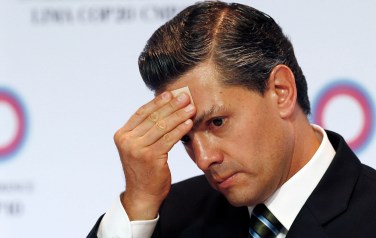
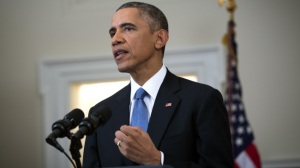
If President Enrique Peña Nieto envisioned his visit to Washington to meet President Barack Obama as sparking favorable coverage abroad and revitalizing his tarnished international image, the reality fell badly short.

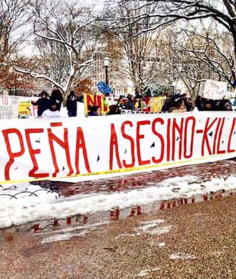
Protestors gathered in the snow outside the White House to denounce the president, Imagen1with one banner proclaiming “Peña – killer” in red letters. ABC even reported that the small demonstrations held in Washington D.C. and at least 20 other U.S. cities overshadowed the day, embarrassing the Mexican leader.

In fact, domestic concerns over a failed rebellion in Congress, and Obama’s veto threat to the House were what really upstaged the visit. Last month’s seismic announcement that the White House would restore diplomatic ties with Cuba can’t have helped either, as mainstream U.S. media seems to have temporarily maxed out its interest in Latin American affairs.

For Peña Nieto, the discussion of trade and energy were key. Here was a chance to promote his big plan A: the implementation of reforms to put Mexico on a path to economic growth.

Yet Cuba and immigration topped Tuesday’s agenda. Obama urged Mexico to halt the flow of immigrants, and Peña Nieto praised the “very audacious decision” to normalize ties with Havana.

There were no big announcements and none of the major U.S. TV channels covered the visit. Newspapers running the story all referred to the problems Peña Nieto was facing at home.

After weeks of speculation in Mexico, Obama did mention the case of the disappeared students of Aytozinapa. “Obviously we’ve been following here in the United States some of the tragic events surrounding the students whose lives were lost,” he told reporters after the meeting. “Our commitment is to be a friend and partner with Mexico in its efforts to eliminate the scourge of violence and drug cartels.”

Yet there was no condemnation of Peña Nieto’s handling of the crisis and many advocates had been hoping for more.

“Mexico is facing its worst human rights crisis in years, with security forces committing horrific abuses that are rarely punished,” said Daniel Wilkinson, managing director of the Americas division at Human Rights Watch. “The Peña Nieto administration has so far failed to take this crisis seriously, and President Obama has been unwilling to call them on it.”

Before the Ayotzinapa case put insecurity back in the news, Peña Nieto was having considerable success promoting his plan A of economic growth. Mexico was sold as a country in reform, reaching for transparency and ripe for investment. His decision to take on the telecommunications monopoly and open up the energy sector had earned him praise abroad, culminating in a Time Magazine cover showing him under the headline, “Saving Mexico.”

Then came the scandals and his fortunes nosedived. The mass kidEnrique Pena Nietonapping of 43 students from Ayotzinapa Teachers College sparked a wave of protest. The authorities displayed terrible judgment, cracking down on dissent in a way that recalled Mexico’s undemocratic past. The President made matters worse. He described the unrest as a plot to “destabilize” the country and neglected to meet the parents of the missing students until over a month after their disappearance.

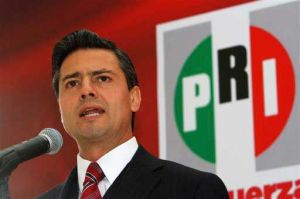
The official narrative that Peña Nieto was heading a revitalized and transparent Institutional Revolutionary Party (PRI) became harder to sell. The PRI had been out of power since 2000, when their 71-year rule came to an end. They were re-elected in 2012 on the promise that they would restore order, while steering clear of repression and corruption.

Yet backed into a corner, the party reverted to its old tactics. Peña Nieto repeatedly condemned the protest movement, police beat demonstrators and the 20 November march in Mexico City led to the temporary jailing of 11 people in maximum security prisons.

Desalo_Manifestantes_Zocalo-3

Police attack protesters in Mexico City.

Yet while the PRI hasn’t moved on, Mexico has. As journalist Katherine Corcoran’s points out Peña Nieto “is facing a Mexico much changed in the years since the PRI left office, when the country was still largely isolated, had very little investigative media and no citizen watchdogs armed with cellphone cameras and social media.”

The revelation that a government contractor had provided the president and his wife with a $7 million mansion has furthered the sense that this is the same old PRI. Peña Nieto’s approval rating has plummeted, reaching 39 percent by December according to Grupo Reforma. To put that into perspective, even his predecessor, Felipe Calderon, whose presidency was marred by rising violence, had a rating of 66 percent in 2012.

If the president has any chance of reversing this trend he badly needs his neoliberal reforms to bolster the economy. Trips abroad to exchange pleasantries with world leaders simply won’t cut it. So far, his plan A has devalued the peso, driven gas prices up and stagnated job growth.

Peña Nieto acknowledged the economy was paramount in his first public appearance of the year in Oaxaca.

“This year of 2015 we will feel the first effects of the reforms that we have enacted in the first two years of this administration,” he said. “It will be the families themselves, the Mexican people, who will be the judges of our actions. They are the ones who can measure and evaluate the benefits the reforms yield.”

Unfortunately for Peña Nieto, neoliberalism in Mexico has never seemed to work. From the signing of the North American Free Trade Agreement (NAFTA) in 1994 to the present, deregulation and privatization have promoted inequality, with a knock-on effect on crime that has contributed to the kind of violence currently miring his reputation.

Many economists, both in Mexico and abroad, view the reforms as necessary and long overdue. Yet if neoliberalism fails once again, Peña Nieto’s government may be badly wishing it had a plan B.

Twitter: @Stephentwoodman

Posted in Politics | Tagged , , , , , | Leave a comment

Mexico 2014 – The year of the internet meme

In Mexico, humorously captioning photos has become something of an art form. Social media in 2014 was buzzing with these internet memes, which are spread virally online via Facebook and Twitter, or through instant messaging service WhatsApp.

New technologies are often said to disconnect and distract, but internet memes are often topical, and keep young users politically informed and engaged.

Whilst television is traditionally Mexico’s favorite media, its polished and uncritical coverage rarely attains the insight of a well-produced meme.

In 2014, the capture of drug cartel kingpin Joaquin “El Chapo” Guzman smexicoparked a torrent of online satire. The long-time fugitive was given the title “Former Hide and Seek World Champion.” The wildfire way the news spread was also satirized, with one meme depicting Robin checking his smartphone and saying “they captured Cha…” before being slapped by Batman. “We know already!” the superhero shouts.

The World Cup led to a broad variety of memes.

“No era penal,” (that wasn’t a penalty) was the phrase of the tournament for Mexicans. The expression refers to Holland player Arjen Robben who was accused of diving against Mexico and forcing their elimination from the competition.

The phrase was bandied around so much that it came to derive its humor from the very fact of its comic repetition. The joke in oNo-era-penal-1ther words, was that it was everywhere. Socrates’ paradox “I know that I know nothing,” was changed to “I know that wasn’t a penalty.” The Hollywood sign was replaced with the phrase, whilst Chilean poet Pablo Neruda’s famous love sonnet was updated to conclude with the saying.

In November, a property scandal forced First Lady Angelica Rivera to release a video defending her expensive lifestyle. The former soap star declared that media company Televisa paid her $10 million in 2010. The revelation led to a storm of online content deriding her and the suspiciously lucrative deal. With neither of the two major television networks, Televisa or Azteca, criticizing authority, it was up to social media to keep people informed.

Hollywood actor Leonardo DiCaprio was shown lifting a champagne glass and saying “screw this, I’m going to Televisa.”Another meme offered a quick solution to Mexico’s economic struggles. “If she does a couple more soaps, we’ve paid the external debt!”

In December, Finance Secretary Luis Videgaray got dragged into a similar scandal. It was revealed that he owned a $500,000 property registered in the name of the same 10-memes-que-arremeten-contra-Luis-Videgarayengineering firm that had built Rivera’s home. One meme showed Videgaray’s face photoshopped onto Rivera’s. Staring out from his flowing blonde hair, the politician looks pleadingly at the camera. “I worked as an extra,” he says.

Such examples show that the internet can lend a dissenting voice, totally distinct to that of television and radio. Nevertheless, there is a downside, as online content has a tendency towards discriminatory language, disseminating racist, sexist and homophobic messages.

The National Council for the Prevention of Discrimination (Conapred) monitors social media and denounces what it considers to be inappropriate content. It has no power to remove it, but it uses the functions provided by social media to complain.

“The problem with these materials is that they are reproduced in the collective imagination,” said Conapred’s Social Media Subdirector Valeria Berumen Ornelas. “They make discrimination seem like something normal.”

One controversial meme depicted indigenous Mexicans in a variety of situations with the suffix “tl” tagged to a phrase, in imitation of the Nahuatl language. The Nike catchphrase became “JUST DO ITL,” and this was added to a picture to an indigenous woman running.

Linguistics Professor Alejandro Alcomiztli Netzahualcoyotl Lopez believes that this form of mockery can have extremely negative consequences. “Prejudicial attitudes towards indigenous languages have contributed to their loss of vitality, which could eventually lead to their extinction,” he said.

Following the de10606444_10205444193688256_1862877223200343264_nath of comic Chesperito, another meme made light of the disappearance of 43 students in Guerrero. “Now we’re missing 44,” was the caption to a photo of the late comedian.

Certainly, internet memes leave little room for nuance. Many are unfunny, offensive and discriminatory. Yet in 2014, they served a vital function, keeping young people informed in a year of important political change.

By mocking political authority, memes form part of a longstanding satirical tradition in the country. This runs from the recent political movie “The Perfect Dictatorship” to the centuries-old practice of dressing up as a politician or a priest for a fiesta.

In his famous essay The Labyrinth of Solitude, the poet Octavio Paz says that the fiesta allows for a temporary breakdown of the social order, a much needed opportunity to mock authority. “By means of the fiesta society frees itself from the norms it has established. It ridicules its gods, its principles, and its laws.”

In much the same way, the internet meme inverts the strict social hierarchy, offering a grassroots form of communication that anyone with a computer can get involved in. Most importantly, it proves that no one, no matter how rich or powerful, is beyond being laughed at.

Twitter: @Stephentwoodman

Posted in Culture | Tagged , , , , , , , , | Leave a comment

Mindfulness movement on the rise in Mexico

meditation-3480814_1920

Students in Guadalajara have been taking part in an innovative university course that teaches them to meditate for course credit.

For the past six years, lecturer Cristina Preciado has been training students at the Western Institute of Technology and Higher Education (ITESO) to focus their minds on the present, becoming observers of their breath and the sensations in their body.

“Through this self-observation you acquire self-knowledge,” Preciado told themexicanlabyrinth.com. “You become conscious of who you are, what you say, where your thoughts are. Normally they’re in the past or future but we’re not even aware of that.”

The process gives insight into the habits of the mind. “You become more conscious and change things that are not serving you,” Preciado says.

A typical class opens with group sharing, in which students give feedback on their personal meditation practice, which begins as a five-minute daily exercise and gradually extends to half an hour as the course progresses.

In the next stage of the class, there is a guided meditation, where the students are verbally directed by the teacher.

According to Preciado, one of the great challenges of a course like this is deciding how to grade. “We had a whole semester of experts coming to help us find evaluation instruments, but we’re still not certain.”

The grade is partly based on participation but next semester this will be changed to stop extroverted students dominating.

To pass the course, students are expected to read the bestselling book by meditation teacher Eckhart Tolle: “The Power of Now: A Guide to Spiritual Enlightenment.”

“I have to make it very clear to them that they need to read the book and then they write a report, following certain guidelines,” Preciado says.

Despite the challenges in evaluation, the course has been a huge success. “The three groups fill up the day of the first registration and there are always students who still want to get in but can’t,” Preciado says. “Why am I saying this? It sounds like bragging. What I’m really trying to say is thpower_of_nowat it works. It really works. The people who put it into practice, it changes their lives. So it has to do with them really, I just share the information.”

So doesn’t Preciado see a problem with mixing education and spirituality?

“Well, academic courses will train you to be a good architect, engineer, psychologist, but an academic education is very limited. You can’t really be a good psychologist, a good engineer if you are not at peace internally. You’ll be affected if you have issues, problems with your family, problems with your co-workers.”

Meditation, however, can help you to maintain focus.

“You’re going to be a better person, and you take that person, yourself, with you, wherever you are, in any area. So there is no conflict. On the contrary, I would say it is detrimental for schools not to teach meditation.”

Preciado also refers to the increasing body of scientific and psychological research demonstrating that meditation can help people regulate their emotions, overcome addiction and deal with physical pain.

“There is a lot of scientific proof that meditation helps and a lot of very successful people  meditate. It’s not a hippie thing.” she says.

DSC_0017

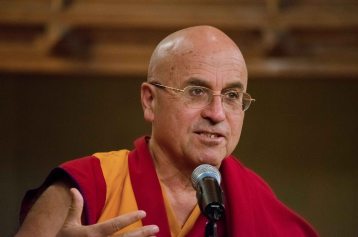
Buddhist monk Mathieu Ricard

Preciado’s message is similar to that of Mathieu Ricard, the French Buddhist monk and writer who was dubbed the “happiest person in the world” after U.S. neuroscientists scanned his brain. The test found he had an enlarged left prefrontal cortex, suggesting an “abnormally large capacity” for joy, thanks to years of meditation practice.

Ricard, whose lecture “Cultivating Happiness in Daily Life” was a sellout when he visited Guadalajara last July, is uniquely placed to outline the science behind happiness and meditation, being both a monk and a cellular geneticist.  His central argument is that we all believe in the benefits of intellectual and physical exercise, but neglect emotional development. We think that we can simply decide to be more compassionate, without working on it.

“We do exercise every morning 20 minutes to be fit,” he says. “We don’t sit for 20 minutes to cultivate compassion. If we want to do so, our mind will change, our brain will change. What we are will change.”

vipassana-meditation-natural-adhd

A Vipassana meditation hall

Liz Llamas, a 21-year-old ITESO student from Guadalajara, says she obtained similar benefits from attending one of the notoriously intense Vipassana retreats just outside Mexico City. These courses, which are held in centers around the world, last for ten days and are completely silent, with students meditating for ten hours a day. The wake up bell is rung at 4 a.m., with short breaks for rest and two daily meals, both eaten before noon. It’s a movement that started in India, and is popular with all ages and social classes. One of its fundamental principles is that the course is given as charity, so there is no fee, and only students who have completed it can give a donation.

“It was very challenging,” Llamas told themexicanlabyrinth.com. “The first days were easier, but as the course came to a close, despite feeling more at peace in myself I was also getting more desperate to get out.”

Yet Llamas is certain that the meditation practice was beneficial.

“It was a rich experience, and I learnt a great deal. With regards to my personal life I found answers that I didn’t have before. Things cleared up. I don’t think it was easy to complete the course, but by the end, I was a much happier person.”

Twitter: @Stephentwoodman

Posted in Spirituality | Tagged , , , , , | Leave a comment

The legacy of Samuel Joaquín Flores, Mexico’s most controversial church leader

Luz del Mundo’s Guadalajara temple

Close to 600,000 people flooded into Mexico’s second-largest-city, Guadalajara, this month to pay respects to Samuel Joaquín Flores, the 77-year-­old head of the evangelical Luz del Mundo (Light of the World Church), who died on 8 December.

Known to his flock as the “Servant of God,” Joaquín Flores’ body lay in repose for a week in the vast Guadalajara temple, dressed in a dark suit, whilst two rows of believers, one for men, and one for women, filed past for a final glimpse of their leader. The line grew steadily, and it is estimated that church members, many of them weeping inconsolably, had to wait at least four hours to see his body.

“I feel like when my parents died,” Luz del Mundo follower José Luis Ceron Rosales said. “Nothing compares to that man. At least I’ve never met anyone else like him.”

“It’s a feeling of irreparable loss,” César Augusto Candelaria said. “We understand that he was the mouth of God on earth, but humanity hasn’t always celebrated its men of God.”

sj10101

Samuel Joaquín Flores

To these devotees, Joaquín Flores was an apostle and visionary preacher with a direct line to the Creator. To others, he was a spiritual and sexual opportunist who fostered a personality cult with himself at the center.

Either way, Mexico has lost one of its most important religious figures. In the five decades since Joaquín Flores took over leadership of the church, Luz del Mundo became the richest and fastest growing Pentecostal church in the country. Membership expanded to an estimated five million people in 37 countries, and the church established itself as a major political force.

Formed by Aaron Joaquín Gonzalez, the father of Joaquín Flores, in 1926, Luz de Mundo describes itself as a return to uncorrupted Christianity.

Women wear long skirts and are forbidden from makeup or jewelry. The sexes are separated during services and no dancing or clapping is allowed, but weeping and speaking in tongues are encouraged. There is a strong emphasis on family values and marriages are mostly kept within the community. Alcohol and dating are strictly forbidden.

The church is known for its bizarre architecture, including a mock Taj Mahal in Chiapas, Mexico and a replica Mayan pyramid in Honduras.

918006_640px

The enormous Guadalajara temple was completed in 1992, and is decked out with flashing neon-lights and a multi-colored ceiling. The housing surrounding the structure is sold to believers at reduced prices, so church members make up the vast majority of the neighborhood. The streets have names like Jordan and Nazareth, and a Ministry for Honor and Justice keeps tabs on locals, making sure they pay their tithes and dress appropriately.

Rival evangelical churches have often complained that Joaquín Flores built a cult of personality. Renée de la Torre, a Mexican sociologist and expert on the church, supports this claim, but points out that this was established by Aaron, not Samuel.

“Many Pentecostal churches disagreed IMG_1844with the way in which the church sanctified Aaron, and later Samuel. For example, the main church celebrations are related to important dates in the leader’s lives, such as birthdays. The hymns and prayers were focused on Aaron, and then Samuel, and not so much on the figure of Jesus Christ.”
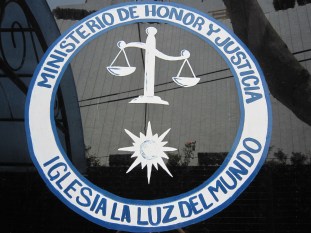
Throughout his leadership, the Catholic Church frequently complained that Joaquín Flores sought political power and manipulated his relationship with the ruling party.  He was accused of securing special treatment, such as cheap water and electricity for the temple neighborhood, in exchange for encouraging his followers to vote as a bloc.

A few days after the Heaven’s Gate mass suicide in San Diego, California, Mexican Protestant theologian Jorge Erdely Graham even accused Luz del Mundo of having similar potential. In fact, no evidence was ever produced to support the claim.
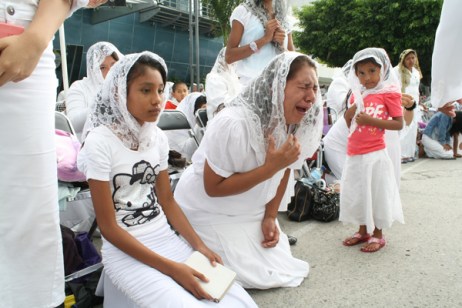
Weeping followers of Samuel Joaquín Flores

Erdeley Graham also claimed that Joaquín Flores formed an elite group of highly trusted devotees who worked as a kind of secret police. They operated a network of informants and suppressed dissent using a range of tactics, from verbal intimidation to torture. According to Erdeley Graham, these devotees were so close to the leader that he would arrange their marriages, and name their children.

Allegations of rape and sexual abuse were also thrown at the church. One of the accusers was kidnapped and stabbed 57 times in an attack he blamed on Luz del Mundo, although Joaquín Flores  was never found guilty of any crime.

Yet these criticisms did little to damage the leader’s standing, and probably strengthened an authority that was always defined in opposition to the outside world.

“Within the church they spread the message that he was a victim of attacks from the exterior,” de la Torre told themexicanlabyrinth.com. “This was also taken as proof of his saintliness, because Christ was crucified in much the same way. This type of strategy is very recurrent when there are scandals in religious environments.”

Luz del Mundo representatives have argued that critics are simply intolerant of their faith. These persecution fears may be more than paranoia, given that over 80 percent of the population is Catholic and the Vatican has often reacted with hostility to the growth of Protestantism in the area. “Sects, like flies, need to be gotten rid of,” claimed Catholic spokesman Girolamo Prigione.

“In a sense the Catholic Church has been a little bit envious,” anthropologist Patricia Fortuny told themexicanlabyrinth.com. “The followers of Luz del Mundo are comprised of the lower social classes and there are millions of them.”

It is this group in particular that the Roman church has struggled to engage in recent years, with a range of new religious movements gaining ground among Mexico’s poor. Evangelicalism has risen, as has interest in the cult of Holy Death.

IMG_1831

The nine-tiered, multi-coloured ceiling of Luz del Mundo’s Guadalajara temple

Nevertheless, Catholic Cardinal Jose Francisco Robles Ortega, the Archbishop of Guadalajara, was among those who sent a personal letter of condolence to the family, suggesting a new, more diplomatic approach to an increasingly powerful organization.

“I think the mistreatment of the church has lessened,” sociologist Luis Rodolfo Moran told themexicanlabyrinth.com. “They have integrated into Guadalajara society, although they are still seen as peculiar outside of the city.”

Jalisco State Governor Aristoteles Sandoval was careful to make a personal appearance for the funeral, suggesting that the church still has an extensive political reach.

Joaquín Flores will be succeeded by his fifth son, Naason Joaquín Garcia, 45, who announced that he had received a divine message calling him to lead.

The new church leader said that he had sought counsel from God to help with the pain of bereavement when suddenly he received the message.
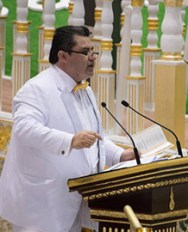
nason-joaquin-santa-cena-la-luz-del-mundo-samuel-jaoquin-sajofitas1

Naasón Joaquín García

“I heard a powerful blaring voice, like a tide of rushing water,” he told the congregation. “It asked, ‘why are you asking me to comfort you? You must comfort my people!’ I thought it was someone playing a joke on me but there was nobody there and I was surprised and scared. I fell to my knees. The voice said, ‘Naason, you are the Head of this ministry.’ I told him, ‘no, not me.’ I said that when my father died I already had a destiny but he told me, ‘no, your destiny is with me and with these people that I entrust to you.’”

Twitter: @Stephentwoodman

Posted in Religion | Tagged , , , , | 7 Comments

Mexico welcomes Obama’s move to embrace Cuba

Political analysts have signaled that the agreement to restore diplomatic ties between the United States and Cuba could have positive economic consequences for Mexico.

barack-obama-cuba

U.S. President Barack Obama made the Cuba announcement on December 17

President Enrique Peña Nieto spoke with Cuban President Raul Castro on the phone and congratulated him following the announcement. The University of Guadalajara – a long-time supporter of the Castro regime – issued a statement thanking both governments for making “the decision to overcome the tensions and difficulties of their shared past.”

Cuban and Mexican relations have improved in recent years after over a decade of distance during two successive National Action Party (PAN) administrations. This is in part driven by commerce, which increased in 2010 and 2011 and has remained stable since.

Peña Nieto further strengthened ties by visiting the island and condoning 70 percent of its debt to Mexico.

“The clear message that these measures send to the hemisphere is that we all want Cuba to become an integral part of the region, to play its full role therein and to begin the process of removing the last vestiges of the Cold War in Latin America,” said former Mexico diplomat Andres Rozental.

Many experts now predict a bright bilateral future.

“There are going to be certain changes, though they won’t all be major,” said Tec de Monterrey Business Professor Manuel Valencia. “There won’t be a substantial rise in new businesses, but those that already have experience in the area will definitely take advantage of the situation.”

Fidel Castro launched his Cuban revolution in 1956, after sailing from Mexico in a yacht. Following the overthrow of Fulgencio Batista’s regime in 1959, Mexico maintained close diplomatic ties with its socialist neighbor, despite the hostility of the United States.

Yet when conservative Vicente Fox became president in 2000, he adopted a more hostile stance, which culminated in a spat between the two leaders. In 2002, Fox ordered Castro to rush away from a diplomatic summit in Mexico before then-U.S. President George W. Bush arrived. “Eat up and leave,” he was alleged to have said.

Obama’s announcement was greeted with concern by some commentators, who were unhappy that Canada and the Vatican, rather than Mexico, organized the secret talks between the nations. Historically, Mexico has prided itself on playing a mediating role in the region.

Twitter: @Stephentwoodman

Posted in Politics | Tagged , , , , | Leave a comment

Annual telethon comes up short as negative press holds back donations

Teleton, Mexico’s largest telethon that urges television viewers to donate money for the rehabilitation of children with disabilities, has suffered its worst ever year and last week was forced to extend its annual broadcast by four hours to reach its target of charitable donations.

The troubles follow criticism from the United Nations that Televisa, Mexico’s largest broadcaster that runs the Teleton, presents disabled children as “subjects of charity.”  Some have even suggested that the downturn reflects a broader phenomenon, which Senator Luis Miguel Barbosa described as “a national crisis of credibility” following the case of the 43 disappeared students of Ayotzinapa.

The Teleton in Mexico started in 1996 to raise money for disabled children’s rehabilitation centers (known as CRITs). The broadcast normally lasts for 24 hours (this year 28) and contains comedy and music segments. Last year’s Teleton raised $473,794,379 pesos ($32 million). Each year a face of Teleton is chosen to be its representative. This year’s face, comedian Eugenio Derbez, was blasted on social media, with one meme accusing him of charging over $41,000 to appear. derbez-teleton-meme

He wasn’t the only one facing criticism. In the run up to the event, Televisa received negative coverage for its involvement in scandals surrounding President Enrique Peña Nieto and his wife, former soap star Angelica Rivera. The First Lady released a video defending her expensive lifestyle in which she declared that Televisa paid her $10 million in 2010.

The highly lucrative deal was viewed with suspicion by some media outlets. Televisa already had a reputation for being close to the president, and had been criticized in the past for helping his rise to power.

Several commentators, including some working for Teleton, acknowledged the possible impact of Ayotzinapa on the event. Televisa journalist Carlos Loret de Mola complained: “For the Ayotzinapa case you should look to the mayor of Iguala and his wife, the governor who protected them, the Party of the Democratic Revolution (PRD), Lopez Obrador (former presidential candidate) who helped hide the case, the political class for the violence sweeping the nation. But do disabled kids need to pay for this?”

74786_84a6d9baac

The 2014 United Nations report describing the Teleton as a promoter of stereotypes also impacted the event. The Committee on the Rights of Persons with Disabilities (CRPD) urged people to avoid donating money.

Teleton President Fernando Landeros countered that the investigators had never even visited a rehabilitation center.

Lingering suspicions surrounding the event may have finally come to a head. Televisa has been repeatedly accused of using Teleton as a huge tax evasion scam, although the broadcaster deny this. “Tax deductions do not equal tax evasion,” notes one comment on their website.

Another persistent complaint is that it is not citizens, but the government’s responsibility to provide for disabled children. The United Nations expressed concern that “much of (public) resources for the rehabilitation of people with disabilities are in private management entities such as Teleton.”

Jorge Serrano, in an open letter to Eugenio Derbez, said: “if the people in charge of dividing and allocating the necessary amount of resources for each category of requirements within the country don’t do their job then that is not the responsibility of the people.”

Law professor John M. Ackerman argued: “Instead of tending to the symptoms, we need to uproot and transform an unjust system that permanently generates more poor, malnourished, sick, exploited and disabled people.”

Another criticism of the program is that too much of the donated money is spent on building opulent rehab centers, and could be better invested in more modest facilities and thus reach a wider number of needy children and reduce waiting lists.

Twitter: @Stephentwoodman

Posted in News | Tagged , , , , | Leave a comment

Visiting president provides sharp contrast to Mexico’s leader

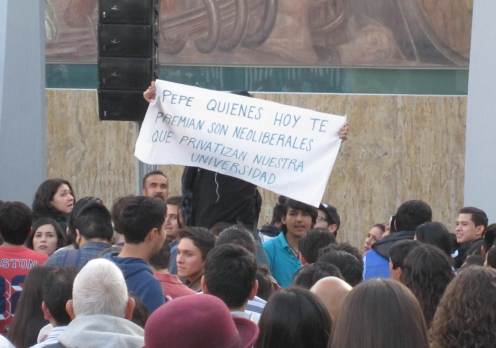
“Peña should go! Pepe should stay!” was the chant rising from the crowd of about 500 students clustered outside the University of Guadalajara’s Salvador Allende assembly hall. The mostly young audience had gathered on a cool Saturday evening to await the arrival ofa 79-year-old head of state.

Imagen2

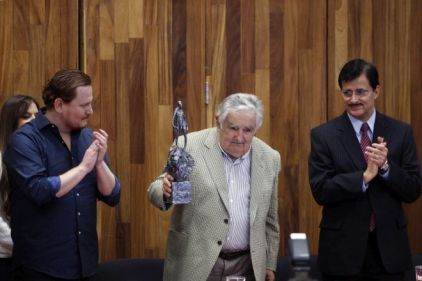
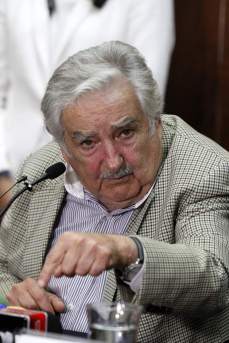
The man they were there to see is the President of Uruguay, Jose “Pepe” Mujica, who was in town to collect the “Lionheart award” from the Guadalajara Student Federation, a prize previously given to the famous journalist Carmen Aristegui, and the priest and activist Alejandro Solalinde, among others.

There was a boisterous atmosphere, and the introductory speech given by Rector Tonatiuh Bravo Padilla was greeted by a chorus of boos. Padilla praised the state of democracy in Mexico, while the crowd outside the hall chanted “liar” in unison.

Alberto Galarza, the President of the Student Federation (FEU) fared little better. He gave a florid and emotionalized speech, which the Uruguayan leader, projected onto the big-screen outside, was shown to be listening to with a displeased expression.

Galardón Corazón de León a José Mujica, Presidente de Urugua

Uruguay President José Mujica with Alberto Galarza, the President of the Student Federation (FEU), to his right and Rector Tonatiuh Bravo Padilla, to his left.

He even opened his own discourse with a gentle rebuke: “What a tragedy it would be if I was younger man and I took all this eulogizing seriously,” he said, tapping Galarza, who was seated at his side, on the arm.

“I can see in all the applause and the clamor that I’m not being seen as I truly am,” he declared, modestly. “Yet I can also detect a hope and a necessity to believe. Because to live, we must believe in something.”

Mujica went on to give an impassioned speech, peppered with jokes and Uruguayan slang, in which he lambasted consumerism and inequality for 45-minutes without glancing at any notes.

He listed his priorities: love, children, a group of friends; and criticized a work culture that draws people away from what is important in life. In the modern world: “you don’t have time to be friends with your own children.”

He spoke about the true value of money: “When you buy something” he declared, in his gravelly tone, “you don’t buy it with your money, you buy it with the time from your own life that you spent working to get that money!”27552-944-1416

This obsessive pursuit of money is something he believes has tainted politics. Yet Mujica was careful not to condemn the world of business: “Each to his own. If you’re after dollars, by all means go into business, I applaud you, and if it goes well, you can pay your taxes.”

Public service however, “is not a profession, it’s a devotion,” and politicians should live accordingly.

The audience of Mexican students, listening with rapt attention, was of course aware of the relevance of all this to their own society. The Mexican President Enrique Peña Nieto has recently been embroiled in a scandal related to a number of properties used by him and his wife that are registered in the name of a firm that had received public contracts during his time as Mexico State governor. Mujica made no reference to the Mexican leader, but the significance of his words cannot have been lost:

“If I have an illness or a heart attack, what I need is a good cardiologist. If you need to govern public institutions, you need people that are not affected by the interests of these institutions.” If this is not the case: “democracy is kidnapped.”

Unlike Peña Nieto and his wife, with their lavish properties, Mujica refused to live in the presidential palace, opting instead to stay in his little bungalow.

The palace “is a relic of the old culture of monarchism,” and not a suitable dwelling for the leader of a democratic republic. “A president must live like the majority in his country, not like the minority,” Mujica said.

In contrast to Angelica Rivera, the First Lady, who announced that she declared $10 million to the tax authorities in 2010, Mujica collects an annual salary of $150,000 and gives 90% to charity. He dresses simply and drives a battered old Volkswagen Beetle.

vw

The presidential vehicle

News of his upcoming visit was greeted with excitement by Mexicans on social media. “We wish we had someone like him governing us,” tweeted Daniela Becerra. “Let’s switch presidents! Wait no, that would be unfair on Uruguay!” said Fernando Omar.

So why does the president of a distant South American country attract such a following? Whilst it’s largely due to his unconventional personality, there are real indications that there is substance behind the style.

Uruguay under Mujica has experienced robust economic growth, and the gap between rich and poor has declined, making it the most equal country in Latin America. At the same time, neoliberal policies in Mexico have devalued the peso and reductions in inequality have been relatively modest.

Whilst Mexico has suffered the effects of prohibition, and the financial empowerment of drug traffickers, Uruguay has made marijuana legal in an effort to curb black market profits and free up police resources.

Of course, Uruguay has a tiny population, smaller than that of Guadalajara. This makes it more nimble, manageable, and perhaps more open to experimental policy making.

Mujica’s international reputation, moreover, is not matched by his approval rating at home, which at 47%, is better than most of his predecessors, but nothing spectacular.

Yet in Mexico, the Uruguayan leader received a hero’s welcome, adored by the very same protestors that have had enough of Peña Nieto and long for a president who comes from outside of the establishment.

Mujica didn’t explicitly mention the cause of Mexico’s recent protests: the disappeared students of Ayotzinapa, but he did encourage citizens who are calling for an end to state violence:

“The only people who can be defeated are the ones that give up. You can fall one, two, three, or fifty times, but it’s always worth getting up again.”

pena-nieto-y-jose-mujica-efe

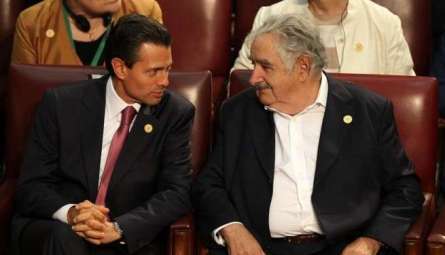
Mexican president Enrique Peña Nieto in conversation with Mujica

Twitter: @Stephentwoodman

Posted in Politics | Tagged , , , | Leave a comment

How did Mexico’s First Lady make $10 million dollars in 2010?

Angelica Rivera, the wife of Mexican President Enrique Peña Nieto, was forced to release a video statement on Wednesday, defending herself against accusations of “a conflict of interest” after her mansion home was found to be registered in the name of a company that had received contracts from her husband during his time as governor of Mexico State.

In the video, Rivera, a former soap opera actor, set out to justify her wealth and revealed details of her finances, saying: “I have nothing to hide.” Among her claims was the shocking revelation that her employer, the media company Televisa, paid her 131 million pesos ($10 million) in 2010*.

The statement sparked an intense reaction from journalists and bloggers, and Rivera came under heavy fire, particularly on social media, where she was the butt of an endless stream of jokes and memes. Mexican soap actor Ana De la Reguera, who had moved from Televisa to rival company Azteca for better pay, tweeted: “So why did I go to Azteca, and then Los Angeles if Televisa pay so well?”

angelica-rivera-memes_14The Hollywood actor Rob Schneider joked that he would love to work on a Mexican soap opera, and Rivera’s daughter Sofía Castro was even insulted in Las Vegas by a woman who accused her family of robbing Mexico.
Following the video, it emerged that other more famous actors such as Gloria Trevi, Thalia and Veronica Castro had signed 5 year deals with Televisa worth $500,000 to $600,000 a year; a fraction of the amount that Rivera reported.

Univision correspondent Enrique Acevedo found her explanation unsatisfactory: “So is Angelica Rivera the best paid actor in the history of Mexican television and cinema?” he asked.

Journalist Javier Garza Ramos pointed out that Rivera was buying a mansion of $7 million over 8 years at 9% interest, yet in a year made enough to buy it outright. Such a move would have meant that she saved on the interest but still had $3 million to live on.

Amid the furor, some key questions emerged: How could a moderately well-known Mexican soap actor amass such a fortune? Moreover, why was she being paid this amount in a year in which she hadn’t been involved in a single Televisa production?

The suspicion of corruption lingered over the issue and even led people to question whether this was money attained through purely legal means.

Yet it is unlikely that Rivera would declare ilicit funds to the tax authorities. It is possible that the sum does indeed come entirely from Televisa, who perhaps saw in Rivera an opportunity to deepen ties with then Governor Peña Nieto, whom she married in November 2010.

pena-nietoThe Guardian newspaper has published an outline of fees apparently charged by Televisa for raising Peña Nieto’s profile when he became governor in 2005. Yet by late 2010, the situation may have reversed, with Televisa deciding to make an investment in the man who had already established himself as the PRI Party’s likely nominee for the 2012 presidential elections.

Journalist Jo Tuckman has written extensively  on the two main television networks, who control around 90% of free channels, and “are widely perceived to be political kingmakers.”

Televisa’s generous dealings with Angelica Rivera, who was given a Mexico City home upon the termination of her already highly lucrative contract, suggest that the network sought to deepen ties with the couple.

Another possibility is that Rivera’s story is a lie, a hastily fabricated cover story designed to wriggle out of a scandal over a home that she could never possibly afford. It would be short sighted for the First Lady to quote such an eye-catching figure, but it remains a popular theory on social media.

What is beyond doubt is that Rivera’s own defense has drastically altered her image. From a silent First Lady defined almost entirely in relationship to the President, she was transformed overnight into an indignant Mexican Marie Antoinette, a key focus of popular resentment in a country rife with inequality.

* It should be noted that in Rivera’s statement it was unclear whether this amount was annual income or the earnings from work carried out over a number of years as part of a contract. In either case, it would make her among the best paid actors in Mexico, but the difference in earnings is nevertheless huge, and there is an urgent need for clarification on the issue.

Twitter: @Stephentwoodman

Posted in News | Tagged , , , | Leave a comment

The Day of the Dead: How death became a national symbol

In his famous essay The Labyrinth of Solitude the poet Octavio Paz claims that “the Mexican chases after death, mocks it, courts it, hugs it, and sleeps with it. He thinks of it as his favorite plaything and his most lasting love.”

Imagen3

These handmade sculptures of skeletons in everyday situations are a witty reminder of the omnipresence of death

In Paz’s romanticized view, a sense of death is an integral part of the national psyche, and Mexicans are good humored in the face of its inevitability. A skeleton is as Mexican as Uncle Sam is American.

In fact, there are important cultural and political reasons why death became a Mexican symbol, reasons related directly to the rise of revolutionary nationalism. As the author Claudio Lomnitz has claimed: “The nationalization of an ironic intimacy with death is a singularly Mexican strategy.”

Yet Paz was certainly right to claim that daily Mexican life abounds in images of death. Churches house gory crucifixes, newspaper editors splash photos of bloody murder scenes across their front pages, and there is even the notorious cult of La Santa Muerte, where followers appeal to death as a divine entity.

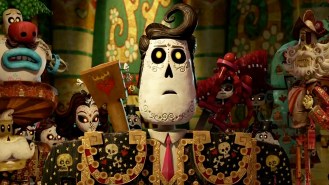
Moreover, there is still a feeling that deaths holds an important place in the culture, as can be seen in “The Book of Life”, the animated adventure film produced by Guillermo del TThe-Book-of-Life-2014-Movie-Skeleton-Manolo-Wallpaperoro. The movie explores themes from Mexican folklore and has a central character who passes into the “Land of the Remembered.”
“What is it with Mexicans and death?” screams a frustrated character in the movie, “We’re just kids!”

The most striking representations of death are found in the annual festival of the Day of the Dead, when offerings are made to the departed. It is a practice that dates back to the Aztecs, who observed a month-long celebration dedicated to the dead.

The modern festival, with its color and vitality, is a feast for the senses. Some have even argued that it is an attempt to escape the non-perception of death. The writer, Roger D. Tinnell, says that “it gives form, it affords sensualism, to that which by its very nature is anti-sensual.”

Imagen2

Artist Issac Cordal leaves minature cement skeletons on the streets of Mexico City

So why did death become an important symbol in Mexican culture? There are four main reasons.

The first is based in the religious beliefs of pre-Conquest Mexico. In the Aztec creation story, it was only through the sacrifice of the Gods that the earth was born. Human sacrifice was in turn necessary to maintain the life of the sun.

Some believe that this cult of sacrifice is still influential today. The late writer Carlos Fuentes remarked that Mexico is a country “where heroes are heroes because they were sacrificed. In Mexico the only saving fate is sacrifice.”

The second reason for death’s symbolic importance is that these Aztec preoccupations were mirrored by attitudes in the Spanish world, which had its very own “culture of death.”

Representations of the suffering Christ in Spain were particularly graphic, and there was a fascination with the “death as leveler” motif, which reminded people that eventually we all face death, regardless of social status.

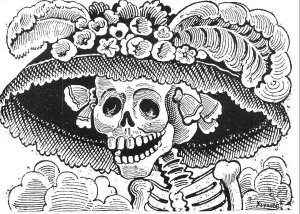
la_catrina_posadas_ocampo

La Catrina by José Guadalupe Posada

The theme was carried into Mexican culture, and can be seen in the figure of La Catrina, the skeleton dressed as a bourgeois lady. The character was first created by the Mexican illustrator José Guadalupe Posada, and it continues the leveler motif, because death has found even this rich, elegantly dressed woman.

Mexican experience forms the third reason for death’s symbolic role in the country. Attitudes inherited from the Aztec and the Spanish were sustained by centuries of death invading life, beginning with the conquest, when disease and war decimated the population to one-seventh of its size.

Later, despite the country establishing itself at independence as a large country that might even expand, it was also the first modern nation state to suffer an early death at the hands of foreign powers, primarily the United States, who executed the “second conquest” of 1848, during which Mexico gave up all of Texas, New Mexico, Arizona, Utah, California, and Nevada as well as parts of Colorado, Wyoming, Oklahoma, and Kansas.

The final and most important reason for the adoption of this peculiar national symbol was the search for Mexican identity that followed the turmoil of the Revolution of 1910-1920. Following this bloody civil war, and particularly following the formation of the Institutional Revolutionary Party (PRI) in 1929, the concept of mexicanidad, a uniquely Mexican identity, became semi-official doctrine.

The philosopher and politician José Vasconcelos was instrumental in promoting the identity of mestizos, mixed heritage Mexicans. In 1925, he published The Cosmic Race, an essay that celebrated Mexico as a futuristic nation that would utter in “a universal dawn of humanity.”

The doctrine was adopted by the revolutionary government, who by this point were already moving away from radicalism and towards protecting established interests.

It was in this context that the death symbol became an important part of government propaganda, with numerous revolutionary intellectuals tackling the theme and with the ruling party encouraging Day of the Dead festivities up and down the country.

Imagen1

day-of-the-dead-patzcuaro-19 The Day of the Dead festival in Pátzcuaro, Michoacán takes place on Isla Janitzio. At night it is lit by thousands of candles.

Death was a convenient emblem, itself a mestizo, combining both the Aztec and the Spanish. It represented an authentic Mexican identity that corresponded well with government doctrine; death was to be promoted, because there was nothing more revolutionary. What better reminder is there that we’re all equal in the end?

In recent years, death has recovered as a radical emblem, but this time, it’s not the government who has taken it up. Every year, the Day of the Dead festival sees campaigners protesting migrant deaths along the border, and altars are dedicated to the victims of the drug war and gender violence. Last year, a storm of online protest forced Disney to drop its attempts to trademark the term “Día de Muertos” for merchandising purposes. The company’s planned 2016 film centered around the festival remains untitled.

So the Day of the Dead retains its macabre vitality, despite efforts to co-opt it. Since being promoted by the state, its power as a symbol has taken on a life of its own.

For Sergei Eisenstein, the Russian director, the death festival was an expression of the Mexican people’s uniqueness and vibrancy. The filmmaker celebrated: “The great wisdom of Mexico about death. The unity of death and life. The passing of the one and the birth of the next. The eternal circle, the enjoying of this circle. Death Day in Mexico. The Day of the Dead!”

viva-méxico-eisenstein-2

A still from Sergei Eisenstein’s Que Viva Mexico!

Twitter: @Stephentwoodman

Posted in Culture | Tagged , , , , , | Leave a comment